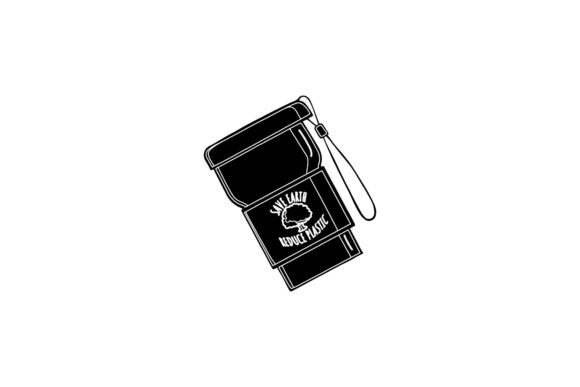
Tumbler Mug Silhouette
A Clean, Quiet Statement — Not a Filler, But a Focal Point
First glance at Tumbler Mug Silhouette tells me this isn’t a busy decorative motif or a whimsical illustrated scene. It’s a single, confident outline—minimal, balanced, and instantly legible. The shape leans slightly forward, suggesting motion or warmth, like steam rising just out of frame. There’s no text, no embellishment, no extra flourishes. Just the mug: tapered base, curved handle, subtle contour variation that implies volume without shading. That restraint is its strength—and its warning. This design doesn’t shout. It waits to be placed thoughtfully.
Where It Lives Best: Real Projects, Not Just Pixels
Last week, I prepped a small-batch run of linen aprons for a local coffee roaster’s pop-up. We needed something elegant but unpretentious—no logos, no slogans, just quiet craft energy. I pulled up Tumbler Mug Silhouette and mocked it on a 3.5" hoop placement over the left chest. At 3.25" tall, it sat cleanly within standard embroidery boundaries, cleared the seam allowance, and left breathing room around the curve of the pocket edge. Stitched in matte black thread on natural linen with tear-away + cut-away stabilizer combo, it read as intentional—not generic, not rushed. Customers paused. Some even asked, “Is that *your* mug?” That’s the kind of resonance a strong silhouette delivers: familiarity, warmth, and implied story—without spelling it out.
What It Does Well (and Where It Asks for Care)
Tumbler Mug Silhouette thrives where clarity and calm matter most:
- Embroidered patches — Its clean edges translate beautifully into sew-on or iron-on formats, especially when backed with twill or denim.
- Tote bag designs — Centered on cotton canvas or heavyweight jute, it reads from across a market stall.
- Baby embroidery — On organic cotton onesies or burp cloths, its simplicity avoids visual clutter while still feeling personal.
- Holiday embroidery — Paired with a single evergreen sprig or minimalist snowflake, it softens seasonal kitsch into something timeless.
- Commercial embroidery — For cafes, bookshops, or boutique studios wanting subtle branded texture—not logos—this works as a recurring motif across staff uniforms, gift tags, and packaging accents.
But don’t assume it’s plug-and-play everywhere. Its minimalism becomes a liability if misapplied:
- On stretchy fabric like performance knits or ribbed cuffs, the smooth curves can distort unless stabilized aggressively and hooped with care.
- On dark fabric, especially charcoal or navy, avoid light thread unless you’re layering underlay or increasing stitch density—it risks reading as faint or unfinished.
- For curved surfaces like caps, test placement first: the handle’s negative space narrows near the crown seam and may compress visually.
- Don’t force it into tiny hoop sizes (under 3"). The handle’s narrowest point loses definition below ~2.25", and the base taper blurs.
- It’s not built for applique design or layered satin stitch fills—it’s a line-first asset. If you want dimension, treat it as an outline only, then build inside manually.
Design Judgment Beyond the File Format
The listing says “6x digital files” including AI and EPS—great for vector scaling—but remember: those are *graphics*, not native embroidery files. If you're using this for machine embroidery, you’ll need to digitize it yourself or hire a digitizer. That means evaluating how the curves will behave as running stitch or satin stitch paths, where underlay matters most, and whether the stroke weight holds up at your target size. A 1920px × 1280px canvas gives plenty of resolution for scaling down, but don’t assume automatic conversion preserves proportion or stitch logic.
I tested it as a digital embroidery file mockup on both light and dark fabric swatches in my design software. On ivory cotton twill, a single-layer fill stitch at medium density gave gentle texture without bulk. On black terry cloth, I added a thin black underlay and bumped density by 12%—it held. But on a textured bouclé sweater knit? It vanished. So yes—Tumbler Mug Silhouette is versatile, but only when matched to fabric behavior, not just aesthetic preference.
For Your Craft Business: Trust, Not Trend
If you’re an Etsy seller or small shop owner, this design quietly supports brand consistency. It doesn’t distract from your product’s function—it enhances it. A customer buying a handmade ceramic mug won’t scroll past a matching embroidered tea towel with this silhouette; they’ll feel the cohesion. That builds trust. Same goes for personalized gifts: monogrammed baby blanket + mug silhouette corner detail = thoughtful, not templated.
But here’s what matters commercially: check the license. Since it’s listed under Freebies, confirm whether it permits resale of finished items or commercial use of the digital embroidery file. Many free graphics allow personal use only—or require attribution. Don’t assume “free” means “unrestricted.” When in doubt, reach out to the creator before listing your embroidered tote bags or selling the digitized version as part of a bundle.
Practical Notes Before You Stitch
- Always test Tumbler Mug Silhouette on scrap fabric matching your final project’s weight and stretch.
- Check thread color contrast in natural light—not just screen preview. Matte vs. glossy thread changes perception.
- Review stitch density: too sparse on thick fabric = gaps; too dense on lightweight = puckering.
- Confirm hoop size compatibility—especially if stitching on collars, cuffs, or curved seams.
- Inspect small details: the handle’s inner curve and base taper should remain distinct, not merge into a blob.
- Test in black-and-white mockups—this design lives or dies on silhouette integrity, not color.
- Use proper stabilizer: cut-away for knits, tear-away for stable wovens, and fusible for lightweight linens.
- Verify licensing before selling finished products or bundling the design as part of your own design assets.
In short: Tumbler Mug Silhouette is a quiet professional tool—not flash, not filler. It earns its place when chosen with intention, tested with care, and stitched with respect for both fabric and audience. Use it well, and it won’t just decorate your project. It’ll ground it.